
Categories List
 China Customs Launches Smart Preclassification Channel for Coatings ExportsAug 16, 2026
- China Customs Launches AI Preclassification Channel for Paint ExportsAug 15, 2026
- 越南要求进口工业涂料提交SVHC声明Aug 14, 2026
- China Customs Opens Smart Pre-Review for Coating ExportsAug 13, 2026
- EU REACH Limits NMP in CoatingsAug 13, 2026
- Shenzhen Fluorosilicone Expo Opens in October 2026Aug 12, 2026




Leave A Reply

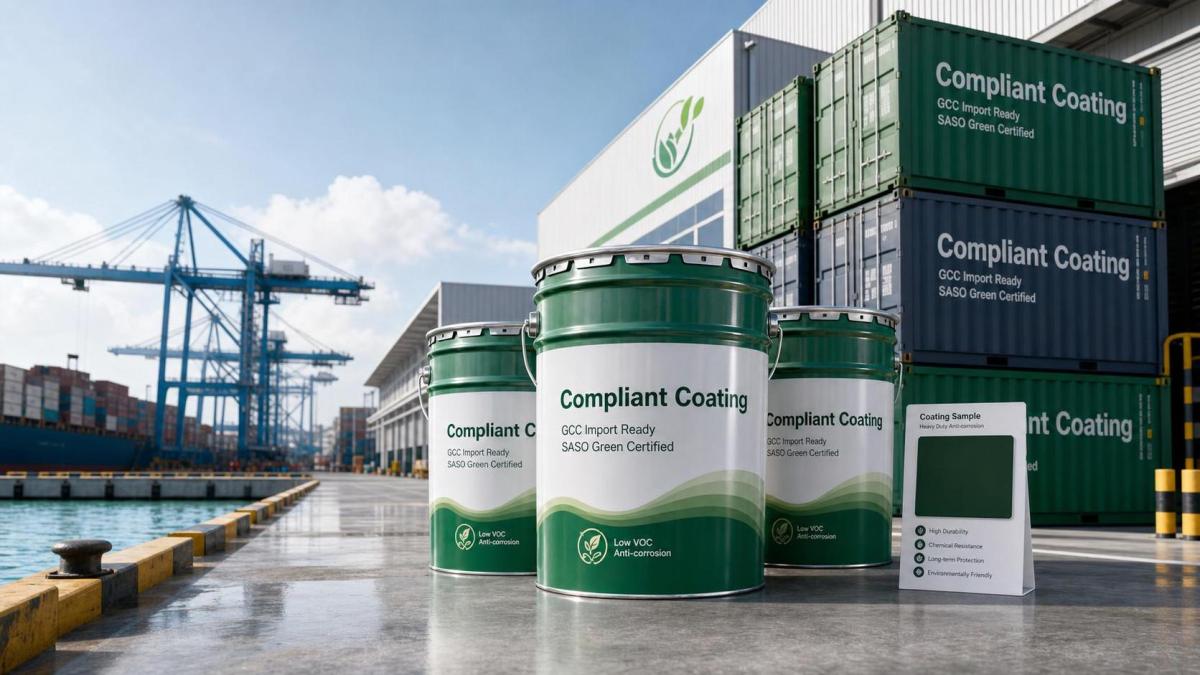
On July 8, 2026, the Saudi Standards body SASO issued an urgent notice that changes the entry requirements for imported industrial protective coatings moving into GCC markets. From August 15, 2026, affected products, including heavy-duty anti-corrosion coatings, must obtain SASO Green Coating certification. For exporters, project suppliers, procurement teams, certification support providers, and port-facing logistics operations, this is worth close attention because it links market access directly to compliance status and may affect shipment timing, document readiness, and coating delivery plans tied to infrastructure work in the region.
What the notice changes from mid-August
The confirmed information is limited but clear on the main requirement. SASO released the notice on July 8, 2026, and set August 15, 2026, as the date from which imported industrial protective coatings entering GCC countries must hold SASO Green Coating certification.
The scope described in the notice includes industrial protective coatings, including heavy anti-corrosion categories. The certification areas named in the summary cover VOC limits, heavy metal migration, renewable raw material ratio, and a carbon footprint declaration.
The notice also states that products without the required certification will be intercepted at Jeddah Port and Dubai's Jebel Ali Port. The user-provided summary further confirms that this policy directly affects JinFeiMa's coating delivery pace and certification adaptation planning for infrastructure projects in the Middle East.
Where the immediate pressure is likely to appear
Export shipments now depend on certification readiness
From an industry perspective, exporters of industrial coatings are likely to feel the impact first because the rule is tied to import clearance rather than only to downstream project use. The practical issue is not just whether a product can be sold, but whether it can move through trade channels without being stopped at key ports. What deserves closer attention is the alignment between product scope, certification status, and shipping schedules before the August 15 implementation date.
Procurement teams may need to revisit approved coating lists
Buyers and project procurement teams may be affected where coating specifications were prepared before the SASO notice. Analysis shows that the new requirement could push procurement review toward compliance documentation, certification validity, and whether the selected coating system can still be delivered on time. For projects already linked to fixed construction windows, the rule may turn coating approval into a time-sensitive purchasing checkpoint.
Manufacturers and formulators face document and testing pressure
For coating manufacturers and processors, the rule matters because the certification scope named in the notice reaches into product formulation and supporting technical evidence. Even without additional published detail in the input, the listed areas such as VOC limits, heavy metal migration, renewable raw material ratio, and carbon footprint declaration indicate that technical files, test support, and product claims will matter more in export preparation.
Logistics and compliance intermediaries may become a control point
Supply chain service providers, trade compliance teams, and certification-related service firms may also see operational pressure. Observably, once interception risk at named ports is explicit, pre-shipment document checks, product classification review, and coordination between exporter, consignee, and certification support functions become more important. The business risk is concentrated in handover timing, customs-facing paperwork, and whether product files are complete before cargo arrival.
What companies should check now
Review whether current products fall within the affected coating scope
Companies shipping industrial protective coatings into GCC markets should first confirm whether their product lines, including heavy anti-corrosion systems, are within the notice scope. This is especially relevant where product portfolios include multiple industrial coating categories and not all lines may be managed under the same compliance process.
Match technical documents to the certification themes named in the notice
Analysis shows that firms should pay close attention to whether existing technical documents can support the themes explicitly referenced in the summary: VOC limits, heavy metal migration, renewable raw material ratio, and carbon footprint declaration. The input does not provide the detailed execution method, so this should be treated as a document-readiness checkpoint rather than a confirmed filing pathway.
Recheck delivery commitments for projects already in motion
For companies with ongoing supply obligations, including JinFeiMa's infrastructure-related coating deliveries in the Middle East, the more immediate issue may be schedule risk. It is more appropriate to understand this as a need to reassess shipment timing, delivery promises, and internal approval gates where cargo could otherwise move without the required certification status after August 15, 2026.
Keep watching for implementation language and tender-side updates
The notice gives the direction of travel, but the input does not include detailed implementation language, tender wording, or port-side operating guidance beyond interception risk. What deserves closer attention is whether later official wording, customer procurement documents, or bid specifications start to reflect stricter certification evidence requirements for affected coating products.
Why this reads as an execution signal, not just a policy headline
Observably, this development is more than a general sustainability statement because the notice ties compliance to an import condition and names port interception as a consequence for non-certified products. That makes it closer to an execution signal than a purely exploratory policy discussion.
At the same time, analysis shows there is still a second layer that requires continued observation. The input confirms the certification requirement and the enforcement consequence at named ports, but it does not provide the full operational detail that companies would normally use to finalize filing sequences, documentary standards, or customer-side acceptance practice. For that reason, the market still needs to watch how the rule is applied in transactions, tenders, and shipment handling.
How the market is likely to interpret this update
In practical terms, this notice should be read as a near-term compliance threshold for imported industrial protective coatings entering GCC markets, with clear implications for export planning and project delivery coordination. It does not by itself confirm every downstream execution detail, but it does establish that certification status is becoming part of market access control for the affected products.
A balanced reading is that the change is already concrete enough to require internal review, while some of the operating details still need verification through subsequent official wording and market practice. For companies exposed to Middle East infrastructure supply, the immediate issue is not broad market forecasting but whether certification preparation, shipping plans, and customer commitments remain aligned with the August 15, 2026 requirement.
Basis of this article and what still needs verification
This article is based on the user-provided news title, event date, and event summary. For events of this type, commonly relevant source categories include official notices, publications from regulatory bodies, customs or trade administration information, industry association updates, standards organization documents, and reporting by authoritative trade media.
No specific official source link was provided in the input, so the exact official publication path still needs to be verified on an ongoing basis. Continued monitoring is also needed for detailed policy language, certification interpretation, tender document changes, port-side enforcement practice, industry feedback, and how affected companies implement the requirement in actual export and delivery workflows.