
Categories List
 China Customs Launches Smart Preclassification Channel for Coatings ExportsAug 16, 2026
- China Customs Launches AI Preclassification Channel for Paint ExportsAug 15, 2026
- 越南要求进口工业涂料提交SVHC声明Aug 14, 2026
- China Customs Opens Smart Pre-Review for Coating ExportsAug 13, 2026
- EU REACH Limits NMP in CoatingsAug 13, 2026
- Shenzhen Fluorosilicone Expo Opens in October 2026Aug 12, 2026



Leave A Reply

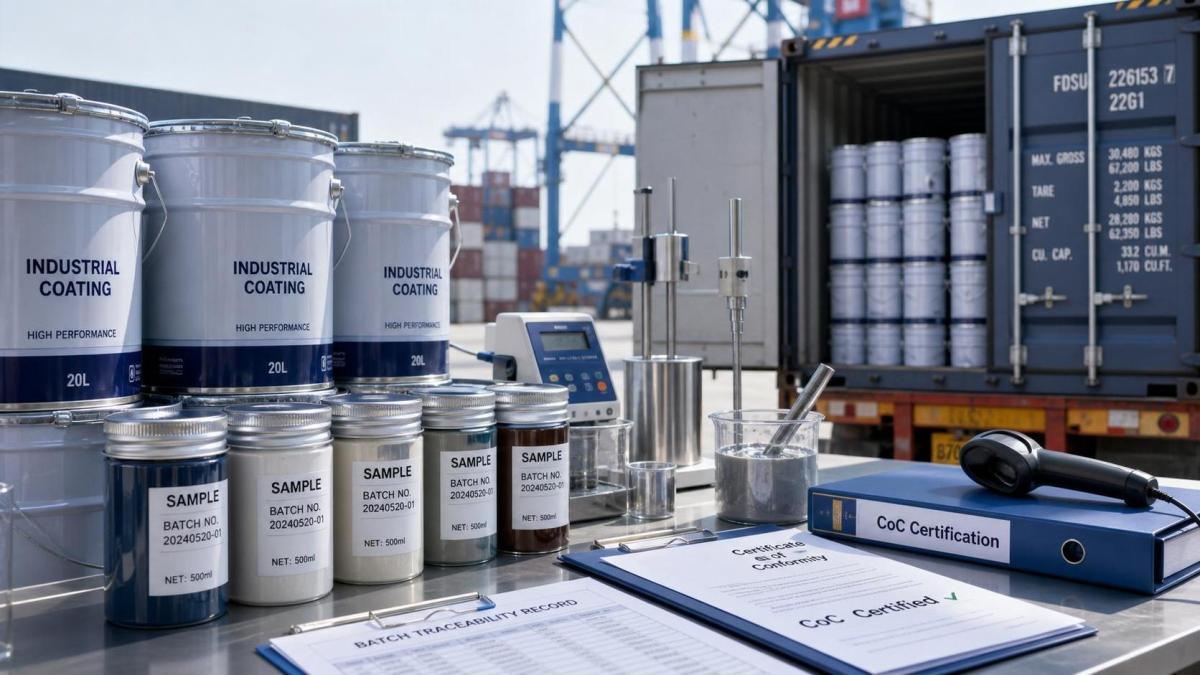
On July 1, 2026, a new customs control measure began affecting industrial coating exports from China to Saudi Arabia, the UAE, Nigeria, and South Africa. Under the new requirement, shipments in this category must complete pre-shipment inspection (PSI) and obtain a certificate of conformity (CoC) before export, with checks covering viscosity, VOC content, heavy metals, and batch traceability. For coating exporters, overseas buyers, and supply chain teams handling time-sensitive orders, the development matters because non-compliant cargo may be detained at origin ports and standard delivery planning now needs to account for an added 5 to 7 working days.
What the New Export Requirement Covers
The confirmed change is specific to industrial coating exports from China destined for four markets: Saudi Arabia, the UAE, Nigeria, and South Africa. Effective July 1, 2026, China Customs requires mandatory PSI and CoC documentation for these shipments.
The inspection scope includes viscosity, VOC content, heavy metal testing, and batch traceability. The enforcement consequence is also clear in the provided information: shipments that do not meet the requirement may be detained at origin ports.
The operational effect already identified is an extension of lead time by 5 to 7 working days, along with higher demands on document readiness for overseas buyers that rely on just-in-time procurement.
Where the Pressure Will Be Felt First
Export execution moves closer to a compliance process
From an industry perspective, direct trading companies and coating exporters are likely to feel the first impact in shipment preparation. The reason is straightforward: export release is no longer only a logistics matter, but also a testing and documentation matter tied to PSI and CoC completion. What deserves closer attention is whether product files, batch records, and test-related materials can be aligned before cargo reaches the port.
Overseas buyers face a narrower timing window
Buyers in the four destination markets may be affected most clearly in replenishment planning. The added 5 to 7 working days can disrupt procurement schedules that are built around just-in-time delivery. Observably, the issue is not only the extra days themselves, but whether documents are prepared early enough to avoid shipment holds at origin.
Supply chain service providers may need tighter document coordination
For logistics coordinators and other supply chain service participants, the change may increase the importance of document checks before booking and dispatch. Analysis shows that when detention risk shifts upstream to the origin port, communication between exporter, buyer, and service provider becomes more time-sensitive, especially for cargo that was previously scheduled on routine lead-time assumptions.
Manufacturing and order management teams may need earlier batch confirmation
For processing and manufacturing businesses shipping industrial coatings, batch traceability requirements may influence internal order release and dispatch timing. From an operational perspective, the impact is likely to appear where production completion, batch identification, and export paperwork are handled in separate steps.
What Companies Should Watch Now
Read the compliance scope in practical terms
What deserves closer attention is the difference between knowing that PSI and CoC are required and being ready to execute them shipment by shipment. Companies involved in the covered exports should focus on whether viscosity, VOC content, heavy metal testing, and batch traceability records can be presented in a form that supports timely customs handling.
Rework lead-time commitments with customers
Analysis shows that the stated 5 to 7 working day extension is not a minor scheduling detail for businesses serving project-based or tightly sequenced demand. Sales, export, and customer service teams may need to review committed shipping dates, especially where buyers depend on just-in-time procurement.
Check whether documentation readiness matches shipment rhythm
The provided information points directly to documentation readiness as a pressure point. In practice, companies should pay attention to whether supporting documents are assembled early enough relative to production completion and port booking, because detention at origin ports creates a different type of disruption than a downstream delay.
Keep watching for how enforcement language is applied
Observably, the current information establishes the requirement and the immediate operational consequence, but businesses should continue tracking whether any later official wording, implementation detail, or procedural clarification affects daily execution. The key issue is how consistently the rule is translated into shipment-level handling.
Why This Looks Like More Than a One-Off Delay
Analysis shows that this development should not be read only as a temporary scheduling inconvenience. The confirmed requirements combine product testing indicators with traceability and documentary conformity, which suggests a stronger compliance threshold at the export stage for affected coating shipments.
At the same time, it would be premature to treat this as a fully settled long-term industry outcome beyond the facts provided. It is more appropriate to understand this as a concrete policy change with immediate operational effects and a broader signal that compliance preparation is becoming more central to export execution in the covered markets.
How to Read the Current Signal
Based on the information provided, the most reasonable conclusion is that the change already matters in day-to-day business terms: it affects release timing, paperwork readiness, and shipment planning for industrial coating exports to four named markets. The immediate consequence is practical rather than theoretical, because non-compliant cargo may be detained before departure.
From an industry perspective, this is best understood as both a short-term operational change and a longer-term compliance signal. It does not by itself confirm wider market outcomes, but it clearly raises the importance of inspection readiness, batch traceability, and customer-side scheduling discipline.
Basis of This Article and What Still Needs Verification
This article is based on the user-provided news title, event date, and event summary concerning tighter pre-shipment inspection and conformity requirements for industrial coating exports from China to Saudi Arabia, the UAE, Nigeria, and South Africa.
For this type of industry update, commonly relevant source categories may include official customs notices, company notices, industry association updates, authoritative media coverage, and standard-related documents. No specific official source link was provided in the input, so the precise official publication path remains to be verified on an ongoing basis.
What still merits follow-up is whether subsequent official clarification changes procedural interpretation, document handling expectations, or shipment-level enforcement practice for the covered exports.