
Categories List
 JFM Paint Strengthens Global Expansion Strategy Through International Market ExchangeSep 10, 2026
 JFM Paint Strengthens Global Presence Through Successful Participation in KOREA BUILD WEEK 2026Aug 27, 2026
 EU REACH Adds 12 New SVHCs, Forcing Industrial Coating Export Declarations UpdateAug 16, 2026
- Vietnam Rule: Industrial Coating Imports Need SVHC Declaration from China Starting Oct. 1Aug 15, 2026
- China Customs Launches Paint Export PrecheckAug 14, 2026
- Nippon Paint Reacquires European Auto Coatings UnitAug 12, 2026



Leave A Reply

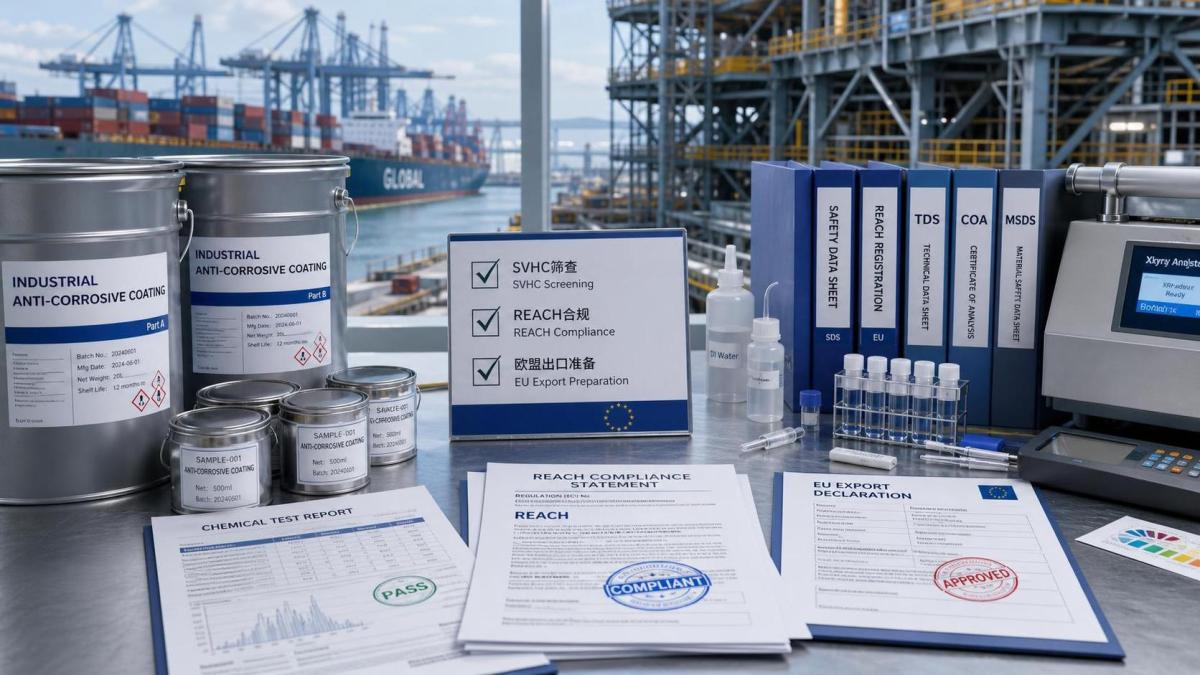
On August 3, 2026, a new compliance trigger emerged for suppliers of industrial protective coatings headed to the EU market: ECHA added five substances to the SVHC Candidate List under REACH, and the change directly touches export documentation for products that contain more than 0.1% SVHC. For manufacturers and exporters serving oilfield service and offshore applications, the issue is not only chemical review but also whether formulation records, SCIP notification readiness, and compliance statements can be aligned before shipment from November 2026 onward.
What Changed in the REACH Compliance Baseline
According to the provided event information, ECHA formally added five new substances to the SVHC Candidate List on August 3, 2026. Two of those substances, identified as a benzo[a]pyrene derivative and a new fluorinated acrylate monomer, are commonly found in curing systems used in high-performance anti-corrosion coatings.
The same event information states that from November 2026, industrial coating products exported to the EU that contain SVHC above 0.1% must be supported by SCIP database notification and a compliance declaration. For Chinese suppliers focused on oilfield service and offshore sectors, including JinFeiMa, this creates a pre-export requirement to complete formulation screening, coordinate with the supply chain, and upgrade technical documentation.
Where the Pressure Will Appear First in the Supply Chain
Exporters of industrial protective coatings
From an industry perspective, exporters are likely to face the most immediate impact because the rule change is tied to market access documentation. The practical issue is not limited to product composition; it also reaches shipment preparation, customer declarations, and file completeness before goods move into the EU channel.
What deserves closer attention is whether products used in oilfield service and offshore environments rely on curing systems that may involve the newly listed substances. Where that risk exists, exporters will need to pay closer attention to SCIP-related filing readiness and the consistency of compliance statements attached to deliveries.
Raw material and formulation management teams
Analysis shows that procurement and formulation functions may be affected at an earlier stage than sales teams, because the event specifically points to two newly listed substances that are common in certain high-performance anti-corrosion coating systems. This means internal review will likely begin with raw material identification, composition confirmation, and screening of existing recipes before any updated external declaration can be issued.
For companies with multiple suppliers, the burden may extend to upstream confirmation of substance content and supporting technical information. The key operational change is that purchasing decisions and formula control may now have a direct effect on whether an export batch can be documented for EU delivery.
Buyers, project contractors, and document reviewers
Observably, downstream buyers and project-facing procurement teams may also need to adjust their document checks. If a coating product exported to the EU falls above the stated SVHC threshold, purchasing parties may need to verify whether SCIP notification and compliance declarations are in place before acceptance, use, or project release.
This matters in sectors where product approval often depends on technical files and supporting declarations rather than only product performance. In practice, document review could become more tightly linked to sourcing approval and delivery scheduling.
What Companies Should Review Before November Arrives
Start with formulation screening rather than paperwork alone
Analysis shows that the first practical step is formulation screening. Because the provided event summary specifically links two of the newly listed SVHC substances to high-performance anti-corrosion coating curing systems, companies shipping to the EU should first determine whether existing products exceed the 0.1% threshold described in the event information.
Check whether supplier coordination is strong enough for declaration updates
What deserves closer attention is supply chain coordination. If substance status needs to be confirmed across several upstream inputs, incomplete supplier responses may slow down document preparation. The event information already indicates that supply chain coordination is part of the required response, so companies should treat upstream data collection as a commercial and delivery issue, not only a regulatory one.
Upgrade technical files with export use in mind
Observably, technical documentation is becoming part of the export gate. The provided event summary states that technical files need to be upgraded, which suggests companies should review whether internal product records, external declarations, and supporting compliance materials are aligned for EU-facing transactions. Where bid documents or customer technical packages rely on older declarations, that gap may need to be closed before shipment.
Keep watching for execution language and customer-side implementation
It is more appropriate to understand this as a rule change with a clear compliance direction, while some execution details may still require monitoring. The input does not provide more detailed official implementation language beyond the November 2026 requirement, so companies should continue watching for customer-side document requests, procurement wording, and any further clarification affecting filing practice or declaration format.
Why This Looks Like an Execution Signal, Not Just a Watchlist Update
Analysis shows that this development should not be read as a routine list update with distant impact. The reason is that the provided event information already connects the listing decision to a November 2026 documentation requirement for EU exports of industrial coating products above the stated threshold. That moves the issue from regulatory awareness into export execution.
At the same time, it would be premature to present this as a fully settled market outcome. Observably, the more reasonable reading is that the compliance direction is already visible, while the exact pace of customer enforcement, document review intensity, and supply chain adaptation still deserve close observation.
How the Market Is Likely to Read This Change
For the anti-corrosion coating segment, especially suppliers serving oilfield service and offshore applications, this update is best understood as a near-term compliance checkpoint tied to export readiness. The main significance lies in the link between substance screening and trade documentation, rather than in a broad prediction about market demand or product substitution.
From an industry perspective, the immediate question is whether companies can connect formulation review, supplier coordination, and technical file updates quickly enough to support EU deliveries from November 2026. That makes this a concrete execution signal with ongoing follow-up needs, rather than a completed end-state for the market.
Basis of This Article and What Still Needs Verification
This article is based on the user-provided news title, event date, and event summary. For this type of development, relevant source categories usually include official announcements, regulatory agency releases, customs or trade authority information, industry association notices, standards-related documents, and reporting by authoritative media.
No specific official source link was provided in the input, so the exact official publication link remains to be verified on an ongoing basis. Observably, the points that still require continued checking include any further policy detail, certification or compliance interpretation, changes in tender or procurement documentation, market feedback from buyers, and how affected companies ultimately implement the required formulation screening, SCIP notification preparation, and documentation upgrades.