
Categories List
 JFM Paint Strengthens Global Expansion Strategy Through International Market ExchangeSep 10, 2026
 JFM Paint Strengthens Global Presence Through Successful Participation in KOREA BUILD WEEK 2026Aug 27, 2026
 EU REACH Adds 12 New SVHCs, Forcing Industrial Coating Export Declarations UpdateAug 16, 2026
- Vietnam Rule: Industrial Coating Imports Need SVHC Declaration from China Starting Oct. 1Aug 15, 2026
- China Customs Launches Paint Export PrecheckAug 14, 2026
- Nippon Paint Reacquires European Auto Coatings UnitAug 12, 2026





Leave A Reply

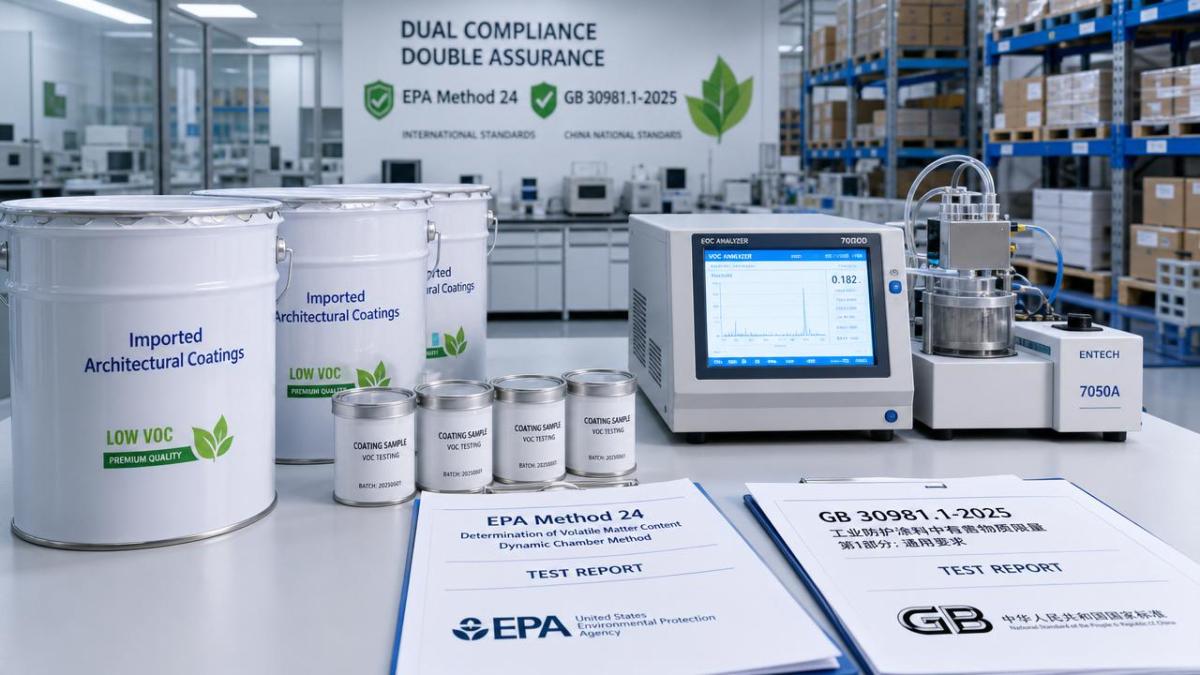
On June 1, 2026, a new compliance condition took effect in Florida for imported architectural coatings: products shipped into the state must not only meet US EPA Method 24 requirements, but also be supported by a full test report under GB 30981.1-2025. For exporters, importers, testing partners, procurement teams, and delivery planners tied to the building coatings trade, this is worth close attention because market access is now linked to two parallel documentation and testing expectations rather than one.
What the Florida requirement confirms
The confirmed information is limited but clear. The Florida Department of Environmental Protection (FDEP) began simultaneous enforcement of an updated VOC control directive on June 1, 2026. Under that requirement, imported architectural coatings sold into Florida must comply with US EPA Method 24 and must also provide a full GB 30981.1-2025 test report. The change means dual compliance has become a mandatory entry requirement for access to this part of the market.
Where the pressure is likely to appear first
Export and import transactions may face a higher document threshold
From an industry perspective, trading companies are likely to feel the change first because market entry now depends on whether both compliance tracks can be demonstrated at the time of sale or shipment preparation. What deserves closer attention is the completeness and consistency of test reports, product files, and commercial documentation used to support cross-border transactions.
Manufacturing and formulation teams may need closer test coordination
Analysis shows that manufacturers supplying imported architectural coatings into Florida may need tighter coordination between product testing and shipment planning. The practical issue is not only whether a product meets one method, but whether documentation aligned with both US EPA Method 24 and GB 30981.1-2025 is ready in a form that downstream partners can use for compliance review.
Procurement and channel operators may need to screen suppliers differently
Observably, buyers, distributors, and channel operators connected to the Florida market may need to pay more attention to supplier qualification and pre-shipment document readiness. The immediate exposure is in purchasing decisions, bid documents, onboarding checks, and acceptance review, especially where imported coatings are expected to enter routine residential or renovation-related supply chains.
Testing and compliance service providers may become more central
It is more appropriate to understand this as a change that increases the operational importance of laboratories, compliance reviewers, and technical document support providers. Their role may expand around test scope confirmation, report completeness, and document alignment, even though the available input does not specify the detailed enforcement process.
What companies should review now
Check whether compliance files cover both standards
Analysis shows that companies should first verify whether existing product files for Florida-bound architectural coatings include both US EPA Method 24 evidence and a full GB 30981.1-2025 test report. If one side is missing, the risk may shift from product qualification to document qualification.
Watch for changes in wording used by customers and counterparties
What deserves closer attention is whether procurement specifications, tender documents, supply agreements, or importer checklists begin to reflect this dual requirement more explicitly. The current input confirms the rule change itself, but not the detailed wording that may later appear in transaction documents.
Reassess lead times around testing and delivery
From an industry perspective, companies should review whether testing schedules, shipment release timing, and supporting paperwork preparation remain workable under a dual-compliance model. This is not yet evidence of a fixed delivery outcome, but it is a practical area that may require earlier planning.
Keep traceability and after-sales records usable
Observably, where compliance questions emerge after delivery, usable technical records, test documentation, and product traceability may become more important. The available facts do not confirm how enforcement will be handled case by case, so maintaining retrievable records is a reasonable precaution rather than a confirmed legal result.
How this signal should be read
Analysis shows that this development is better understood as an implemented compliance signal rather than a tentative policy discussion, because an effective date and concrete dual requirement are already part of the confirmed input. At the same time, it should not yet be treated as a fully transparent enforcement framework, since the detailed execution approach, review practice, and market response are not provided here. That is why ongoing attention to later official wording, commercial adoption, and industry feedback remains necessary.
A practical reading of the change
The main significance of this update is that imported architectural coatings entering Florida now face a clearer two-part VOC compliance threshold tied to both US EPA Method 24 and GB 30981.1-2025 documentation. In practical terms, the event is more appropriately read as a rule already in force with immediate relevance for trade, testing, procurement, and delivery preparation, while the finer points of implementation still merit continued observation.
Basis of this article and what still needs verification
This article is generated from the user-provided news title, event date, and event summary. For events of this type, relevant source categories would typically include regulatory notices, releases from supervisory authorities, customs or trade authority information, industry association updates, standard-setting documents, and reporting by established professional media. No specific official source link was provided in the input, so the exact official publication path still requires follow-up verification. What still needs continued review includes detailed enforcement wording, compliance interpretation, changes in tender or procurement documents, industry feedback, and how companies implement the requirement in practice.