
Categories List
 JFM Paint Strengthens Global Expansion Strategy Through International Market ExchangeSep 10, 2026
 JFM Paint Strengthens Global Presence Through Successful Participation in KOREA BUILD WEEK 2026Aug 27, 2026
 EU REACH Adds 12 New SVHCs, Forcing Industrial Coating Export Declarations UpdateAug 16, 2026
- Vietnam Rule: Industrial Coating Imports Need SVHC Declaration from China Starting Oct. 1Aug 15, 2026
- China Customs Launches Paint Export PrecheckAug 14, 2026
- Nippon Paint Reacquires European Auto Coatings UnitAug 12, 2026




Leave A Reply

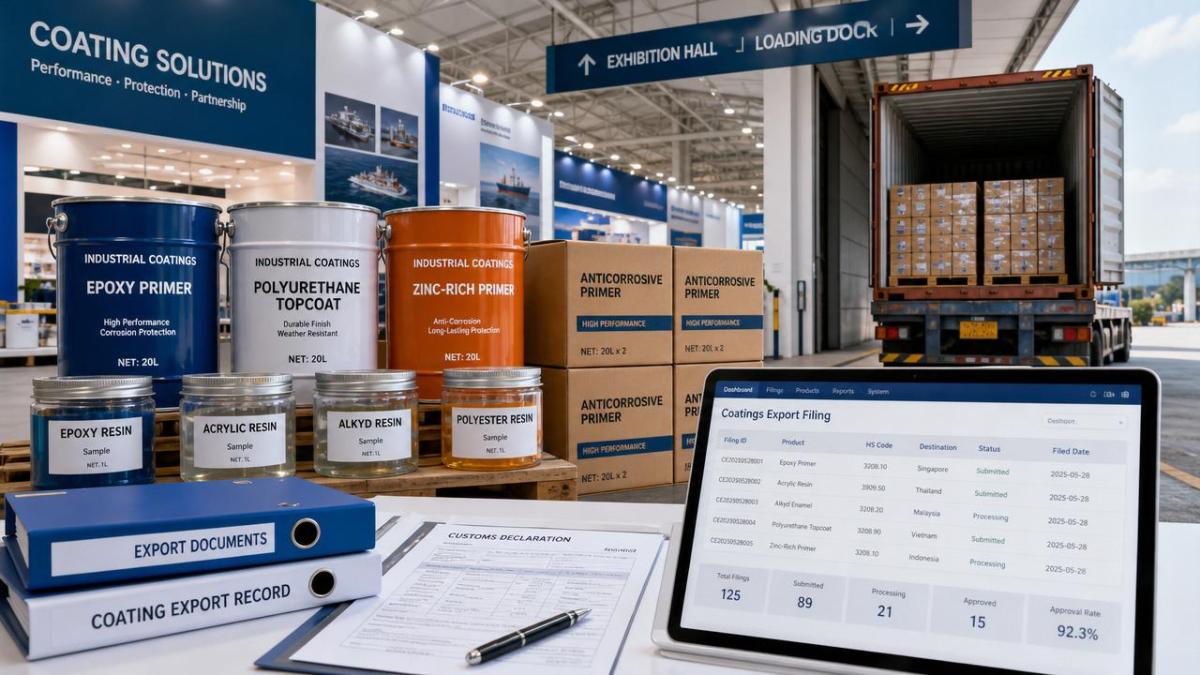
On June 12, 2026, the closing day of the Guangzhou International Coatings Industry Exhibition (ICIE), the Yingde municipal government announced a pilot “48-hour express lane” for export filing covering food-contact materials and industrial coatings for qualified exhibiting coatings and additives companies. The change is worth industry attention because it points to a new execution approach for export-related filing, with potential effects on compliance preparation, shipment scheduling, procurement coordination, and document handling for exporters, manufacturers, and supply-chain service providers linked to the first covered product categories.
A pilot filing route with a shorter processing window
According to the announced information, the pilot is open to qualified coatings and additives enterprises that participated in the exhibition. It is designed for export filing involving food-contact materials and industrial coatings.
The process relies on the Guangdong electronic port platform for online submission, intelligent verification, and cross-department joint review. Under the announced arrangement, the filing cycle is shortened from an average of 15 working days to completion within 2 working days.
The first batch of applicable product categories already covers water-based resins, titanium dioxide dispersions, and solvent-free anti-corrosion primers.
Where the operational impact may appear first
Export-facing manufacturers may need faster internal document readiness
From an industry perspective, companies that export covered coatings or additives may feel the effect first because a shorter filing window can shift pressure upstream into internal preparation. The practical impact is likely to appear in technical file assembly, product description consistency, and the timing of submission materials tied to export schedules. What deserves closer attention is whether existing compliance files, test records, and product documentation can support a more compressed review cycle without creating avoidable resubmission risk.
Procurement and production teams may have to align more tightly with dispatch timing
For manufacturers and raw-material procurement functions, the announced change may matter less as a standalone policy headline and more as a scheduling signal. If filing can move faster for covered products, procurement planning, production sequencing, and delivery commitments may need closer alignment with updated export timing assumptions. Observably, the issue is not only speed, but whether internal handoffs between planning, compliance, and shipping remain consistent when the formal filing stage becomes shorter.
Logistics and trade service providers may face a different coordination rhythm
Supply-chain service providers, including parties handling export procedures and shipment coordination, may also be affected because online submission, intelligent verification, and cross-department joint review can change the pacing of document exchange. The business impact may show up in booking coordination, customs-facing preparation, and communication with clients on filing status. Companies in this part of the chain should watch for how documentary requirements are interpreted in practice under the pilot arrangement.
Buyers and downstream customers may pay closer attention to delivery reliability
For buyers, especially those sourcing covered product categories, the key issue may be whether the new filing pathway improves predictability rather than simply reducing nominal processing days. Analysis shows that procurement teams may need to review supplier readiness, documentation quality, and traceability support when relying on shipments connected to a fast-track filing mechanism.
What companies should watch as the pilot moves into practice
Check whether eligibility and product scope are clearly matched
Companies should first focus on whether they fall within the stated scope of qualified exhibiting coatings and additives enterprises, and whether their products fit the announced first-batch categories. Because the available information is limited to the pilot description, it is more appropriate to treat eligibility review as a priority checkpoint rather than assume broad applicability.
Review technical and compliance files before shipment commitments
Analysis shows that a faster filing lane does not reduce the importance of document quality. Enterprises should pay close attention to the completeness and consistency of product files, technical descriptions, and any supporting compliance materials used in export-related submission. Where filing timing is linked to customer delivery promises, document readiness becomes a practical risk-control issue.
Follow official wording and execution criteria closely
What deserves closer attention is the exact execution language that may emerge after the announcement. The summary confirms online submission, intelligent verification, and joint review, but it does not provide the full operational criteria, review standards, or handling details for exceptions. Companies should therefore continue monitoring official expressions and execution updates before adjusting routine export workflows too aggressively.
Reassess delivery planning for the covered categories
For water-based resins, titanium dioxide dispersions, and solvent-free anti-corrosion primers, enterprises may need to revisit lead-time assumptions in sales, procurement, and shipping coordination. Observably, the current signal is not that all delivery risk disappears, but that filing may no longer be the same bottleneck if the pilot operates as announced.
Why this looks like an execution signal rather than a finished rule change
Analysis shows that this development is best read as a concrete implementation signal with immediate relevance, but not yet as a fully settled rule environment for the wider market. The announced compression from an average 15 working days to within 2 working days is material in operational terms, yet the information provided still centers on a pilot, a defined enterprise group, and specified initial product categories.
From an industry perspective, the more important question now is how consistently the process works in real execution: whether review criteria remain stable, how supporting documents are judged in practice, and whether downstream trade and procurement documents begin reflecting the shorter filing rhythm. That is why continued attention to official clarification, market response, and enterprise experience remains necessary.
How the market may best read this announcement now
At this stage, the announcement can be understood as a targeted procedural acceleration tied to export filing for certain coatings and additives enterprises, not as a blanket simplification across the entire coatings trade. Its significance lies in the shift toward online submission, intelligent verification, and joint review within a pilot framework that may affect compliance timing and delivery coordination for the first covered categories.
A neutral reading is that the development has near-term operational relevance for affected companies, while broader implications still depend on execution details, official follow-up language, and actual industry uptake. In other words, this is a live implementation signal that deserves attention, but it still requires observation before being treated as a settled market-wide rule change.
Basis of this article and what still needs verification
This article is generated on the basis of the user-provided news title, event date, and event summary. For developments of this type, commonly relevant source categories may include official government announcements, regulator releases, customs or trade administration information, industry association updates, standards-related documents, and reporting by authoritative trade media.
No specific official source link was provided in the input, so the underlying official publication path still needs to be verified on an ongoing basis. What still requires observation includes any detailed implementation rules, practical compliance interpretations, filing review criteria, changes in procurement or tender documentation, industry feedback, and how affected enterprises carry out the pilot in actual export operations.