
Categories List
 JFM Paint Strengthens Global Expansion Strategy Through International Market ExchangeSep 10, 2026
 JFM Paint Strengthens Global Presence Through Successful Participation in KOREA BUILD WEEK 2026Aug 27, 2026
 EU REACH Adds 12 New SVHCs, Forcing Industrial Coating Export Declarations UpdateAug 16, 2026
- Vietnam Rule: Industrial Coating Imports Need SVHC Declaration from China Starting Oct. 1Aug 15, 2026
- China Customs Launches Paint Export PrecheckAug 14, 2026
- Nippon Paint Reacquires European Auto Coatings UnitAug 12, 2026





Leave A Reply
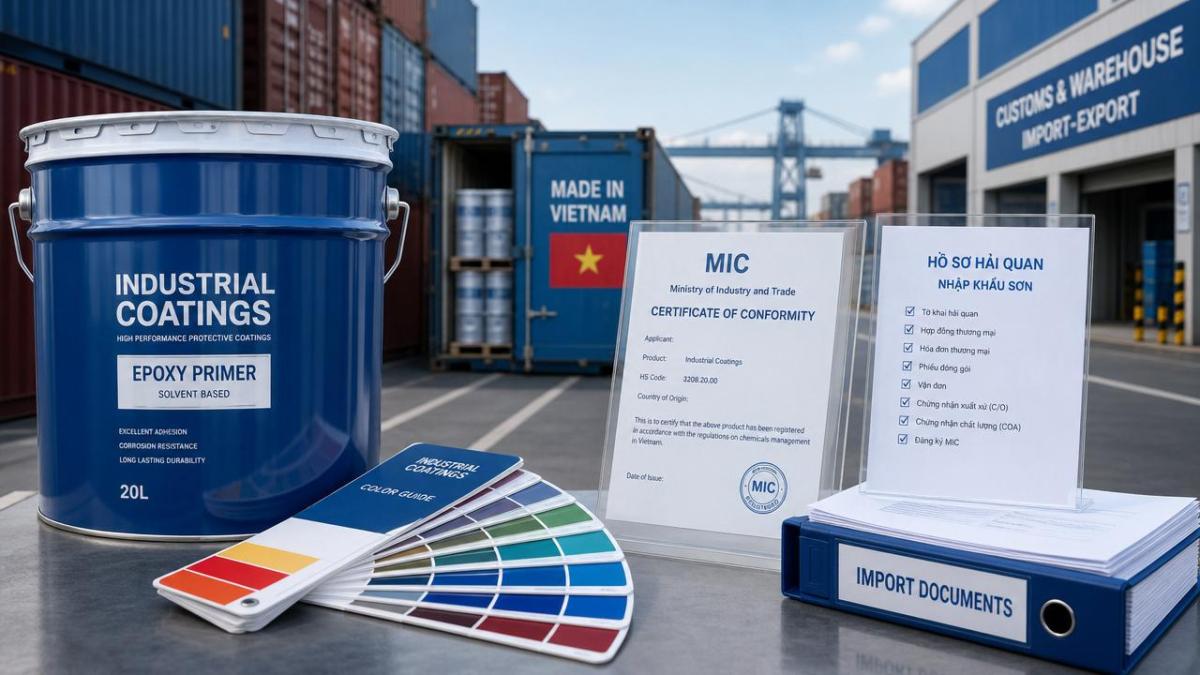
From June 15, 2026, imported industrial and architectural coatings entering Vietnam face a new customs threshold: MIC chemical registration and an electronic registration certificate now become mandatory before customs filing can proceed. The change matters not only to coating exporters and importers, but also to procurement teams, supply chain coordinators, and delivery planning functions because it directly links regulatory readiness to clearance timing.
What the rule now requires at the border
According to the provided event summary, supplementary provisions under Decree 45/2026/ND-CP took effect on 2026-06-15. From that date, all imported industrial and architectural coatings, including water-based, solvent-based, and powder products, must complete MIC chemical registration and obtain an electronic registration certificate.
The rule applies to products under HS codes 3208–3209. If the required registration certificate is not in place, customs will not accept the declaration. The average registration period stated in the input is 25 working days, and no exemption list is provided.
Where the pressure is likely to show first
Trade flows become document-dependent earlier
From an industry perspective, importers and exporters involved in coating shipments to Vietnam are likely to feel the impact first because customs acceptance is now tied to completion of MIC registration rather than being handled as a later compliance step. What deserves closer attention is the sequencing of shipment booking, document preparation, and customs filing.
Procurement and delivery schedules face tighter coordination needs
For procurement teams and buyers sourcing industrial or architectural coatings, the stated average 25-working-day registration cycle may affect ordering rhythm and delivery expectations. Analysis shows that planning assumptions based only on production and transport lead time may no longer be sufficient if registration status is not aligned before shipment execution.
Supply chain service providers may need earlier compliance checks
Logistics coordinators, customs service providers, and related supply chain participants may need to focus more closely on whether the electronic registration certificate is already available before filing is attempted. Observably, the operational issue is not only whether goods are in transit, but whether compliance documents are ready at the point customs review begins.
Coverage across coating categories limits workaround options
The rule covers water-based, solvent-based, and powder coatings within the specified HS range, and the input states that there is no exemption list. Analysis shows that this broad scope may reduce flexibility for companies that previously treated some coating categories as lower-risk from a documentation standpoint.
Practical points companies should review now
Check product scope against HS 3208–3209
Companies handling coatings for the Vietnam market should first review whether their products fall within the stated HS code range and whether they are being treated internally as industrial or architectural coatings covered by the new requirement.
Reassess lead times around registration status
What deserves closer attention is the average 25-working-day registration period mentioned in the input. This does not by itself define the final result of each case, but it is a practical signal for sales, procurement, and shipping teams to revisit shipment timing, customer commitments, and inventory arrangements.
Align filing documents with customs readiness
Analysis shows that document management may become a more sensitive control point. Companies should closely monitor whether product files, registration-related materials, and customs submission documents are organized in a way that supports filing only after the electronic registration certificate is available.
Watch for evolving execution language
Because the input does not provide detailed enforcement guidance beyond the core requirement, it is more appropriate to understand current company action as a compliance preparation exercise rather than assume that all operational details are already settled. Businesses should continue watching for further official wording, execution practices, and any changes reflected in procurement or trade documentation.
Why this looks like an execution signal, not a distant policy note
Observably, this update is not just a policy discussion point because the provided information states that the supplementary provisions have already taken effect and that customs will not accept declarations without the MIC electronic registration certificate. That makes the development more appropriately understood as an implemented market-access condition for covered paint imports.
At the same time, analysis shows there is still reason to watch how the rule is applied in day-to-day trade operations. The absence of more detailed execution language in the input means market participants should pay attention to subsequent clarification, filing practice, and business feedback rather than assume every operational question is already resolved.
How the market may best read this development
In practical terms, this event signals that compliance documentation for imported coatings in Vietnam has moved closer to the front end of customs processing. For affected businesses, the immediate issue is less about broad market interpretation and more about whether registration timing, internal document control, and delivery planning are aligned with the new requirement.
It is more appropriate to understand this development as a rule now in force with direct clearance consequences, while still treating detailed implementation practice as an area that requires continued observation.
Basis of this article and what still needs verification
This article is generated based on the user-provided news title, event date, and event summary. For developments of this type, relevant source categories usually include official notices, releases from regulatory authorities, customs or trade administration information, industry association updates, standard-related documents, and reporting by authoritative media.
No specific official source link was provided in the input, so the exact official publication path still needs ongoing verification. Further observation should focus on any detailed policy language, certification or registration interpretation, changes in tender or procurement documents, market feedback, and actual implementation experience among companies handling covered coating imports.