
Categories List
 JFM Paint Strengthens Global Expansion Strategy Through International Market ExchangeSep 10, 2026
 JFM Paint Strengthens Global Presence Through Successful Participation in KOREA BUILD WEEK 2026Aug 27, 2026
 EU REACH Adds 12 New SVHCs, Forcing Industrial Coating Export Declarations UpdateAug 16, 2026
- Vietnam Rule: Industrial Coating Imports Need SVHC Declaration from China Starting Oct. 1Aug 15, 2026
- China Customs Launches Paint Export PrecheckAug 14, 2026
- Nippon Paint Reacquires European Auto Coatings UnitAug 12, 2026






Leave A Reply

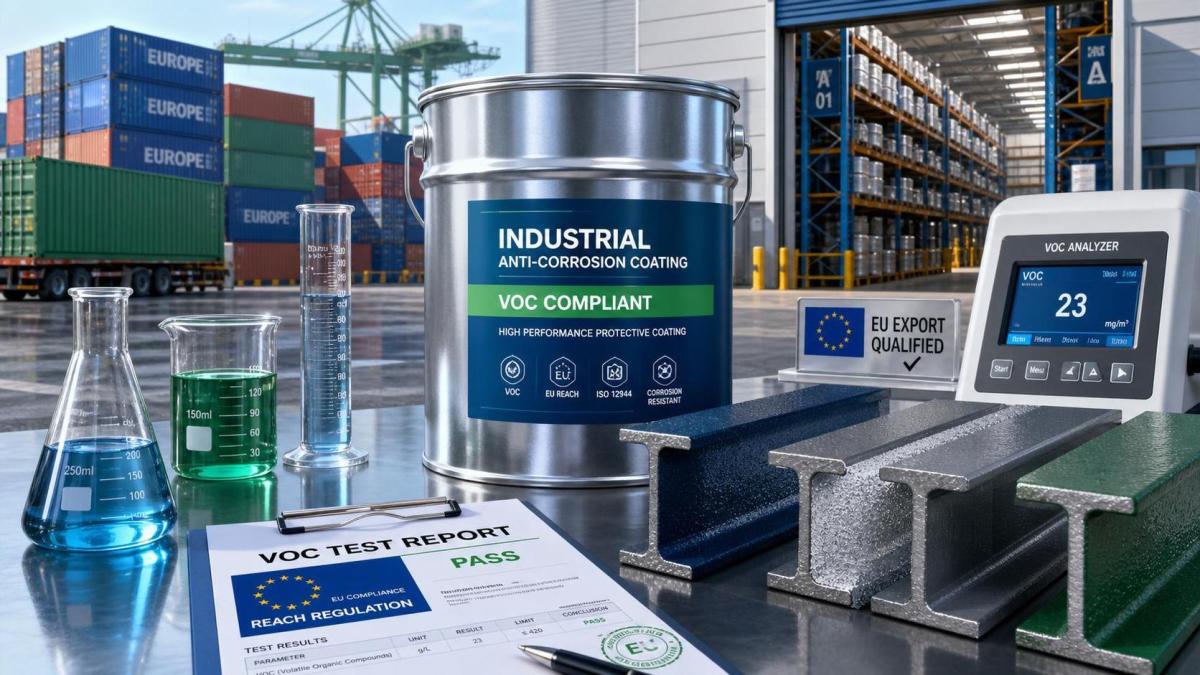
On 2 July 2026, the European Commission adopted Regulation (EU) 2026/1389, setting lower VOC thresholds for industrial coatings entering the EU market and making the new requirements effective from 1 October 2026. For exporters of heavy-duty anti-corrosion coatings used in sectors such as marine, oil and gas, and steel structures, this is not just a product-specification update; it is a market-access change that can affect formulation, certification, import eligibility, and delivery preparation before Q4 2026.
What the new rule now confirms
The confirmed facts are limited but commercially significant. Regulation (EU) 2026/1389 has been officially adopted by the European Commission. It imposes stricter VOC limits on industrial coatings entering the EU market, including a maximum of 350 g/L for anti-corrosion primers and 250 g/L for topcoats. The regulation takes effect on 1 October 2026. According to the provided summary, products that do not comply will be barred from import and from CE marking. The change directly affects exporters of heavy-duty anti-corrosion coatings, particularly those supplying applications linked to marine, oil and gas, and steel structures, and it indicates that reformulation or certification updates may be required before Q4 2026.
Where the pressure is likely to appear first
Export-facing manufacturers will face a direct market-entry test
From an industry perspective, manufacturers shipping industrial coatings into the EU are the most immediately exposed group because the rule ties VOC performance to import access and CE marking. The practical impact is likely to center on product formulations, technical files, compliance review, and shipment readiness for products intended for the EU market.
Procurement and specification teams may need to revisit approved products
What deserves closer attention is that procurement decisions for anti-corrosion primers and topcoats may no longer rest only on corrosion performance or project suitability. Buyers and specification teams dealing with EU-bound supply may need to review whether currently approved products remain aligned with the new VOC thresholds, especially where coating systems were selected earlier and deliveries extend toward or beyond October 2026.
Certification and testing-related service providers may see a documentation shift
Analysis shows that certification-related companies and testing service providers may become more involved as suppliers check whether existing product documentation remains usable under the new rule. The key business impact is likely to fall on compliance files, test records, product declarations, and supporting technical documents needed for import and CE marking pathways, although the precise execution approach is not detailed in the provided information.
Distributors and supply-chain coordinators may need tighter delivery control
For channels handling cross-border delivery into the EU, the issue is not only whether a coating can be sold, but whether it can still be imported and cleared for the intended market after the effective date. Observably, this may affect inventory planning, order timing, and communication between suppliers, distributors, and end customers where product batches overlap with the transition period.
What companies should review before Q4 2026
Check whether current products still match the new VOC thresholds
Analysis shows that companies with EU-bound industrial coatings should first identify which anti-corrosion primers and topcoats fall within the scope of their export business and compare them against the stated limits of 350 g/L and 250 g/L. Where products do not align, the issue should be understood as a compliance and market-access risk rather than a routine formulation matter.
Re-examine certification status and supporting technical files
Because non-compliant products will be barred from import and CE marking, companies should closely review existing certification status, technical documents, test materials, and product data used in EU-facing transactions. The provided information does not specify the detailed documentation route, so this remains an area that requires careful verification rather than assumption.
Watch for changes in tender wording and customer-side requirements
What deserves closer attention is whether customers, project owners, or intermediaries begin updating tender documents, technical specifications, or approved vendor requirements ahead of 1 October 2026. Even before full market execution becomes visible, documentation language can shift earlier than shipment flows.
Align delivery schedules with compliance readiness
Observably, companies supplying long-cycle industrial projects may need to examine whether orders scheduled close to the effective date create exposure in production planning or handover timing. The current information supports caution on scheduling and document readiness, but it does not confirm how all enforcement scenarios will be handled in practice.
How this change is best interpreted at this stage
Analysis shows that this development is better understood as an already landed rule change with immediate commercial relevance, rather than a preliminary policy signal. The regulation has been adopted and an effective date has been identified, which gives companies a clear timing reference. At the same time, it is also appropriate to treat the coming months as a period for continued observation, because the provided information does not include fuller detail on implementation wording, documentation treatment, or how market participants will operationalize compliance checks.
Why the market should keep watching
From an industry perspective, the significance of this update lies in its link between product composition and market access. For affected coating suppliers, the issue is no longer limited to technical performance in service conditions; it also reaches import eligibility and CE marking outcomes. The most reasonable reading today is that the rule change is real and actionable, while the finer points of execution, customer response, and supply-chain adjustment still need to be watched carefully.
Basis of this article and points still requiring verification
This article is generated based on the user-provided news title, event date, and event summary. For developments of this kind, commonly relevant source types may include official announcements, regulatory authority releases, customs or trade administration information, industry association updates, standards-related documents, and reporting by authoritative media. A specific official source link was not provided in the input, so it still needs to be verified on an ongoing basis. Further observation should focus on detailed policy wording, certification execution standards, changes in tender documents, market feedback, and how affected companies implement compliance before the rule takes effect.