
Categories List
 China Customs Launches Smart Preclassification Channel for Coatings ExportsAug 16, 2026
- China Customs Launches AI Preclassification Channel for Paint ExportsAug 15, 2026
- 越南要求进口工业涂料提交SVHC声明Aug 14, 2026
- China Customs Opens Smart Pre-Review for Coating ExportsAug 13, 2026
- EU REACH Limits NMP in CoatingsAug 13, 2026
- Shenzhen Fluorosilicone Expo Opens in October 2026Aug 12, 2026




Leave A Reply

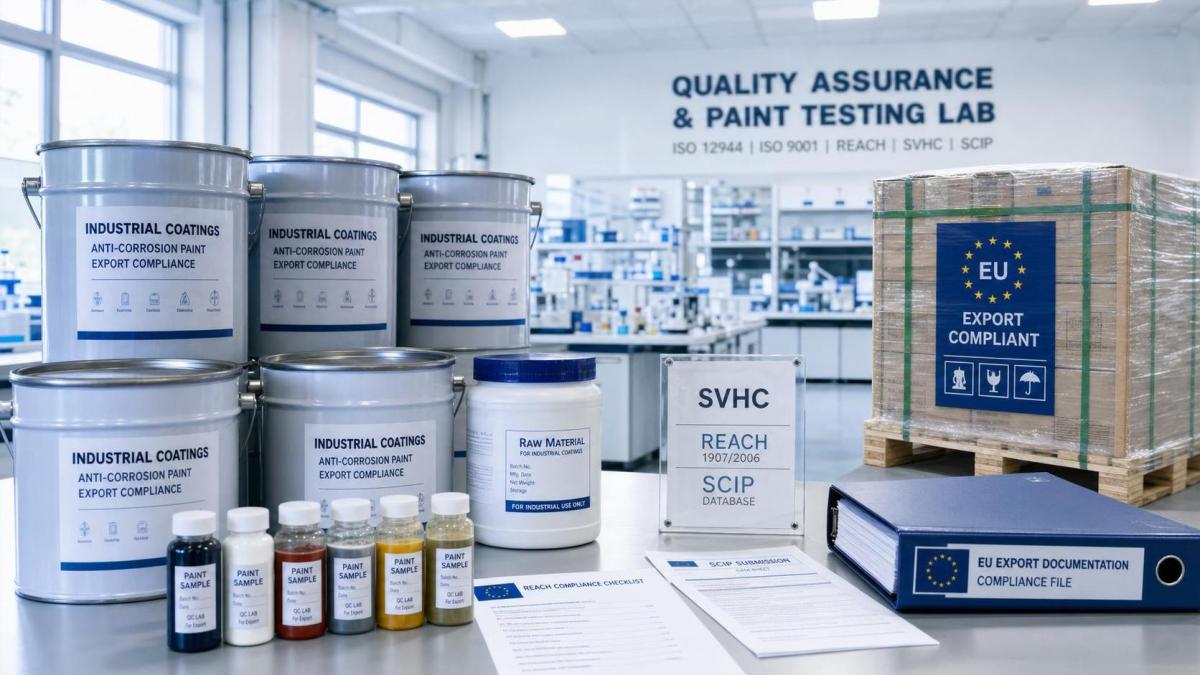
On June 23, 2026, a new REACH compliance trigger emerged for industrial protective coatings shipped to the EU: ECHA added 12 substances to the SVHC Candidate List, including certain organic pigment intermediates and preservative components. For exporters, downstream suppliers, and procurement teams involved in heavy-duty anti-corrosion coatings used in oilfield services, offshore engineering, and infrastructure, the issue is no longer only formula selection but also whether SCIP notification and downstream conformity documentation can be updated in time for shipments from October 2026.
What changed in the REACH compliance baseline
The confirmed change is that ECHA formally added 12 new substances to the SVHC Candidate List on June 23, 2026. The substances mentioned in the event summary include certain organic pigment intermediates and preservative ingredients.
According to the provided information, this update directly affects industrial protective coatings containing the relevant substances, including heavy-duty anti-corrosion coating products exported to the EU.
The same summary states that, starting in October 2026, products exported to the EU that contain the relevant substances must complete notification in the SCIP database and provide a conformity statement to downstream recipients.
The adjustment is described as a mandatory compliance node for Chinese exporters focused on heavy anti-corrosion applications, including companies such as JinFeiMa.
Where the pressure will appear across the supply chain
Export shipments now depend on document readiness
From an industry perspective, direct exporters of industrial protective coatings may be affected first because the rule change is tied to products entering the EU market. The practical impact is likely to appear in pre-shipment review, technical file preparation, and downstream communication. What deserves closer attention is whether product-level declarations and SCIP-related information are aligned before delivery windows begin in October 2026.
Raw material and formulation decisions may need re-checking
Manufacturers and procurement teams handling pigments, intermediates, preservatives, or related coating inputs may be affected where formulations include the newly listed substances. Analysis shows that the main issue is not only sourcing continuity, but also whether existing raw material information remains sufficient for conformity statements and internal compliance review.
Project-based coating supply could face tighter customer scrutiny
For suppliers serving oilfield service, offshore engineering, and infrastructure coating demand, the impact may extend into bid support, technical submissions, and delivery acceptance. Observably, where customers require proof of compliance for heavy-duty anti-corrosion systems, the updated REACH and SCIP obligations may become part of procurement documentation and downstream qualification checks.
Service and support functions may need stronger traceability
Supply chain service providers, distributors, and after-sales teams may also feel the effect if customers ask for updated conformity statements or product traceability records after the October 2026 compliance point. The operational pressure here is likely to center on document consistency across sales, logistics, and customer support rather than on trade execution alone.
What companies should check before October
Review whether affected products are already mapped
Analysis shows that companies exporting protective coatings to the EU should first identify whether any product contains the newly listed SVHC-related components referenced in the event summary. This is a practical starting point because later documentation work depends on knowing which product lines fall within the new compliance scope.
Update SCIP and downstream declaration workflows
What deserves closer attention is the link between SCIP notification and the obligation to provide conformity statements downstream. If internal compliance processes currently treat these as separate tasks, exporters may need to check whether technical, regulatory, and commercial teams can deliver them in a coordinated way.
Check tender files and customer-facing technical documents
For companies active in heavy anti-corrosion applications, it is more appropriate to understand this event as a trigger to review technical dossiers, declaration templates, and bid-related documents. The provided information does not define detailed execution rules, so companies should treat this as an area requiring continued verification rather than as a fully settled documentation standard.
Watch for implementation language and market feedback
Observably, firms should continue monitoring how the requirement is referenced in customer inquiries, contract documents, and qualification requests tied to EU deliveries. The current information confirms the compliance node and timing, but it does not provide a full operational interpretation for every transaction or product scenario.
Why this reads as an execution signal, not just a list update
Analysis shows that this development matters less as a standalone substance-list revision and more as an immediate compliance signal for exporters whose products may contain the affected ingredients. Because the event summary links the listing to a clear October 2026 SCIP and downstream declaration requirement, the market relevance lies in execution readiness.
At the same time, it is more appropriate to understand this as a rule change with confirmed direction but with details that still need observation in practice. Industry participants will likely keep watching how compliance expectations are reflected in procurement checks, technical submissions, and customer acceptance processes.
How this update is best understood now
For the coatings sector, especially heavy-duty anti-corrosion exporters serving oilfield service, offshore, and infrastructure demand, this is best read as a concrete compliance checkpoint rather than a distant policy background item. The confirmed facts point to a rule-linked adjustment with real effects on declarations, SCIP notification, and downstream documentation, while the exact pace of implementation in day-to-day trade still warrants close observation.
Basis of this article and what still needs verification
This article is generated based on the user-provided news title, event date, and event summary. For developments of this type, commonly relevant source categories include official regulatory announcements, releases from supervisory authorities, trade or customs-related notices, industry association updates, standards documentation, and reporting by established professional media.
No specific official source link was provided in the input, so the precise official reference still needs to be verified on an ongoing basis. Follow-up attention should remain on any detailed implementation language, certification or declaration practice, tender document changes, market feedback, and how affected companies carry out compliance execution in response to the October 2026 requirement.