
Categories List
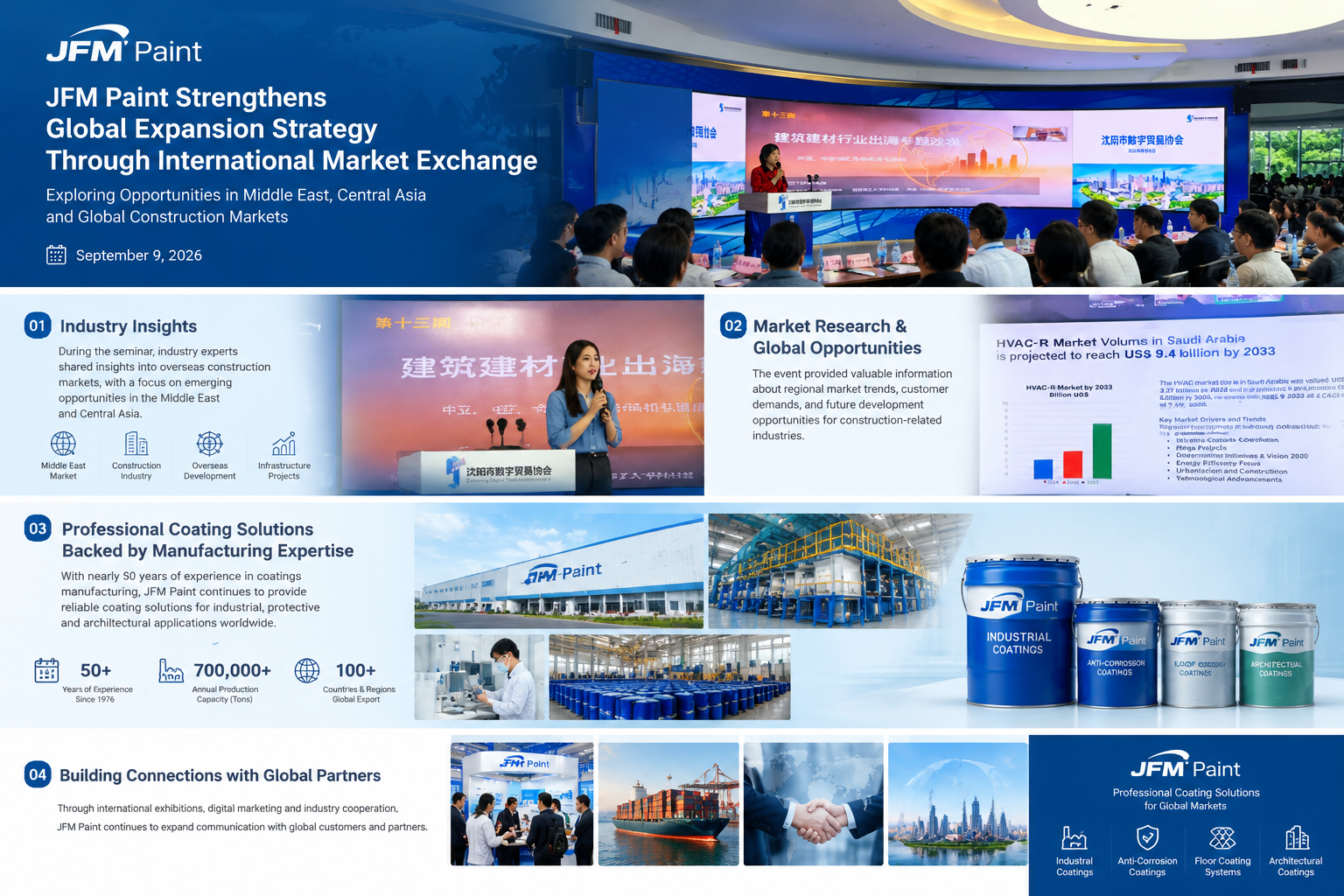
 JFM Paint Strengthens Global Expansion Strategy Through International Market ExchangeSep 10, 2026
 JFM Paint Strengthens Global Presence Through Successful Participation in KOREA BUILD WEEK 2026Aug 27, 2026
 China Customs Launches Smart Preclassification Channel for Coatings ExportsAug 16, 2026
- EU REACH Adds 12 New SVHCs, Forcing Industrial Coating Export Declarations UpdateAug 16, 2026
- China Customs Launches AI Preclassification Channel for Paint ExportsAug 15, 2026
- Vietnam Rule: Industrial Coating Imports Need SVHC Declaration from China Starting Oct. 1Aug 15, 2026




Leave A Reply
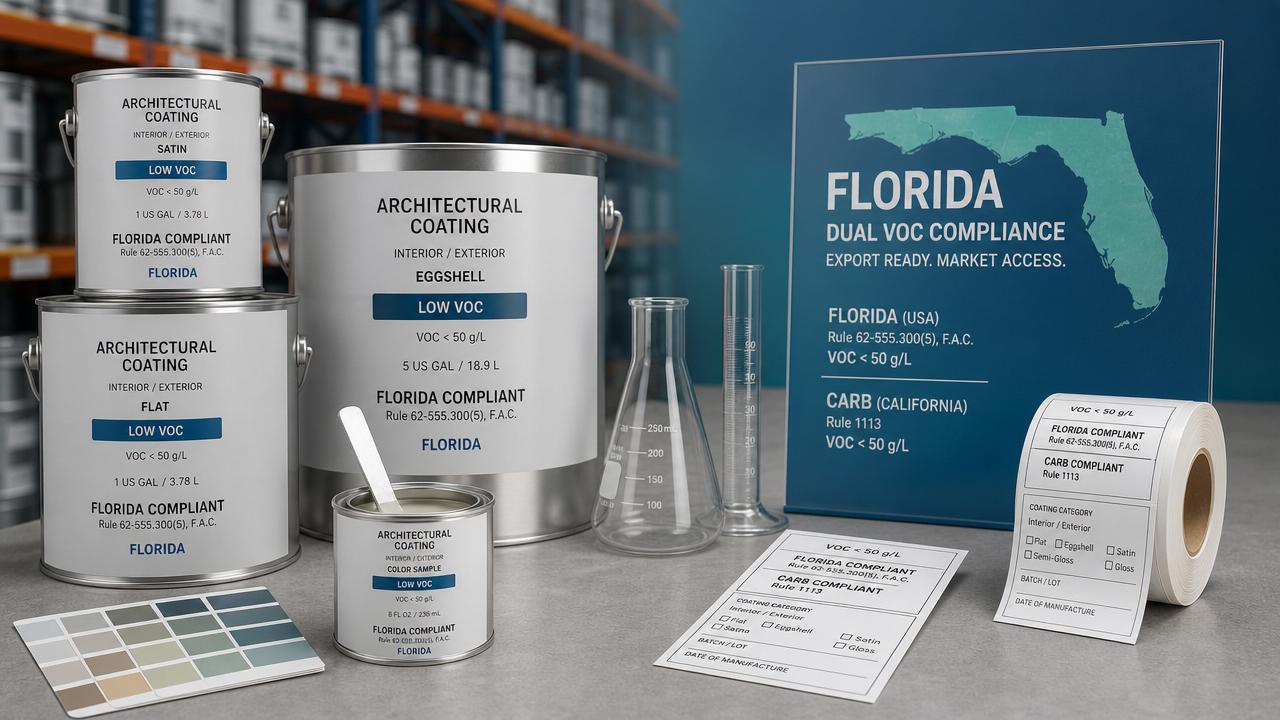
On June 10, 2026, the Florida Department of Environmental Protection (FDEP) put into effect a rule that raises the compliance threshold for certain architectural coatings entering the state. For products made in China and also intended for export to China, the issue is no longer a single-market VOC check: the products must meet both US EPA Method 24 at no more than 50 g/L and China’s GB 30981.1-2025 at no more than 30 g/L, while carrying a dual-compliance statement on the label. This is worth close attention from coating manufacturers, exporters, importers, labeling teams, distributors, and procurement functions because the rule directly links market access to both formulation limits and labeling execution.

What the Florida Requirement Now Demands
According to the provided event information, FDEP formally began enforcing the new rule on June 10, 2026. The rule applies to architectural coatings sold into Florida when the products originate in China and are also planned for export to China.
Under the rule, VOC limits must satisfy two thresholds at the same time: US EPA Method 24 at no more than 50 g/L and China’s GB 30981.1-2025 at no more than 30 g/L. In addition, the product label must include a dual-compliance statement. If these conditions are not met, the products are not allowed to be placed on shelves for sale in Florida.
Where the Pressure May Appear Across the Chain
Export-oriented coating producers face a narrower formulation window
From an industry perspective, manufacturers serving both Florida and China may feel the most direct operational impact. The reason is straightforward: the applicable threshold is effectively shaped by the stricter of the two stated VOC limits, which can affect formulation review, product qualification, and release decisions for relevant architectural coatings.
Import and trading teams need to manage more than customs movement
For importers and trading companies, the impact is likely to appear in product filing, specification confirmation, and shipment readiness. Analysis shows that the rule is not only about whether a coating can be shipped, but whether it can legally reach retail sale in Florida if the dual requirements and label statement are not in place.
Labeling and channel execution become a market-access checkpoint
Distributors and channel operators may need to pay closer attention to labeling accuracy and document consistency. The rule explicitly ties shelf access to the presence of a dual-compliance statement, so the commercial risk may arise not only from formulation nonconformity but also from labeling gaps at the final distribution stage.
Procurement and supply chain coordination may need earlier verification
For procurement teams and supply chain service providers, the practical issue is timing. What deserves closer attention is whether relevant compliance evidence and labeling arrangements are confirmed before goods move into downstream distribution, rather than after arrival or during listing preparation.
What Companies Should Watch Now
Separate confirmed rule text from wider market assumptions
Analysis shows that the confirmed facts are limited to the dual VOC thresholds, the affected product condition, the labeling requirement, and the sales restriction in Florida. Companies should avoid extending this into broader assumptions about other states, other product groups, or additional regulatory obligations unless later official wording confirms them.
Check which product flows fall within the stated scenario
The practical trigger in the provided information is specific: architectural coatings sold in Florida, originating in China, and also intended for export to China. Businesses should therefore review which SKUs, order routes, and customer commitments match that scenario and which do not.
Review labels and technical documents together
Because the rule combines a VOC threshold requirement with a label declaration requirement, companies may need to align technical compliance records with packaging, labeling, and product release documentation. Observably, this is a case where commercial readiness depends on both laboratory-side and label-side execution.
Prepare for customer and channel communication
Importers, distributors, and account teams may need clear internal communication on what the dual-compliance statement means in practice, which products are covered, and what evidence is available. This matters because the consequence described in the event summary is clear: products that do not meet the conditions cannot be placed on shelves for sale.
How This News Is Best Understood at This Stage
Observably, this development is not just a technical adjustment to one VOC limit. It signals that, for the covered products, market access can depend on simultaneous alignment between a US test-method-based threshold and a China standard threshold, plus label wording. That said, it is more appropriate to understand this as a concrete compliance development within the scope described in the provided information, rather than as proof of a broader regulatory shift beyond that scope.
From an industry perspective, the most relevant takeaway today is execution risk. The event already sets a defined enforcement date and a defined sales consequence, but the broader commercial effect will still depend on how many affected product lines, contracts, and channel arrangements actually fall into the stated scenario.
Why the Industry Should Keep Watching
This update is best read as an immediate compliance issue with possible longer-term signaling value. In the short term, it changes the checklist for covered architectural coatings entering Florida under the described origin-and-export condition. In a broader sense, it also highlights how product compliance, standard alignment, and labeling language can converge into a single market-entry requirement.
A neutral reading is the most useful one: this is neither a routine paperwork change nor a basis for overstating wider market outcomes. At present, it is more appropriate to understand the rule as a specific, enforceable development that affected businesses should map carefully against product scope, labeling practice, and sales readiness.
Basis of This Article and Ongoing Verification
This article is generated based on the user-provided news title, event date, and event summary. For developments of this type, commonly relevant source categories may include official regulatory notices, company disclosures, industry association updates, authoritative media coverage, and standard-setting documents.
No specific official source link was provided in the input. Because of that, continued verification is still necessary, especially regarding any later official wording, interpretive guidance, implementation details, and whether any follow-up clarification affects product scope, labeling practice, or enforcement expectations.