
Categories List
 China Customs Launches Smart Preclassification Channel for Coatings ExportsAug 16, 2026
- China Customs Launches AI Preclassification Channel for Paint ExportsAug 15, 2026
- 越南要求进口工业涂料提交SVHC声明Aug 14, 2026
- China Customs Opens Smart Pre-Review for Coating ExportsAug 13, 2026
- EU REACH Limits NMP in CoatingsAug 13, 2026
- Shenzhen Fluorosilicone Expo Opens in October 2026Aug 12, 2026


Leave A Reply
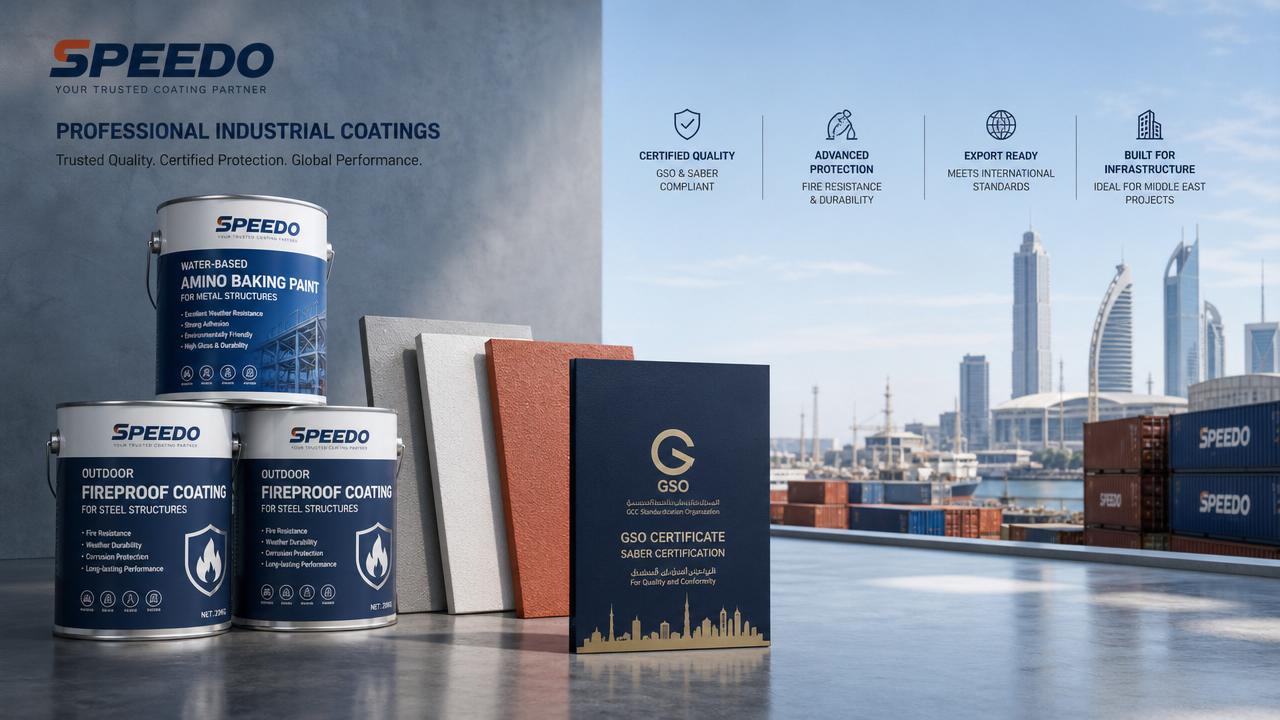
On June 13, 2026, a certification update in the industrial coatings trade drew attention beyond a single company announcement: Shandong Fengsheng Environmental Technology said its core water-based amino baking paint and outdoor fireproof coating lines had passed the UAE ESMA/GSO mandatory fire safety certification under GSO 503:2023. Because this certification functions as a legal market-entry requirement for customs clearance and engineering procurement across the six GCC markets, the development is relevant not only to coating exporters, but also to importers, project buyers, compliance teams, and supply-chain partners that manage bidding, documentation, and delivery schedules.

What Has Been Confirmed in This Certification Update
According to the information provided, Shandong Fengsheng Environmental Technology announced on June 13, 2026 that its main water-based amino baking paint and outdoor fireproof coating series had formally obtained the UAE ESMA/GSO mandatory fire safety certification, GSO 503:2023. The company was described as among the first Chinese coating companies to complete this certification.
The same information states that GSO certification is a statutory access requirement for customs clearance and engineering procurement in the six GCC markets, with particular relevance to petrochemical, infrastructure, and large public building projects. It also states that completion of the certification can reduce compliance risk for Middle East importers, lower local testing costs, and shorten project-based procurement cycles.
Where the Practical Impact Is Likely to Appear First
Export transactions move closer to document-led competition
From an industry perspective, exporters of industrial coatings may be affected because market access in this case is tied directly to a mandatory fire safety certification rather than only to commercial negotiation. The immediate business impact is likely to appear in customs clearance preparation, qualification review, and project tender participation. What deserves closer attention is whether export teams can present certification materials, technical documents, and product scope descriptions in a way that aligns with buyer and project requirements.
Importers and distributors face lower compliance friction
Analysis shows that importers and distribution partners may see the most direct operational change in the compliance and procurement stages. The information provided explicitly points to lower compliance risk and reduced local testing cost. In practice, this means these market participants may pay closer attention to whether certified products can simplify supplier screening, reduce repeated verification work, and improve confidence in procurement planning for project-linked orders.
Project buyers may adjust qualification and tender review priorities
Buyers involved in petrochemical, infrastructure, and large public building projects may be affected because the certification is described as a legal threshold for engineering procurement. The impact is likely to center on prequalification, technical bid review, and supplier eligibility checks. What deserves closer attention is whether procurement files, technical specifications, and supporting compliance documents increasingly treat this certification as a prerequisite rather than an optional advantage.
Testing and compliance service providers may need to follow execution details
Certification-related service firms and testing support providers may also be affected, not because new facts about expanded service demand have been confirmed, but because certification-based market entry tends to shift more work toward document review, test recognition, and conformity support. Observably, these participants should watch how certification language is cited in actual trade and project documentation before drawing broader conclusions.
What Companies Should Watch in Near-Term Execution
Check certification scope against actual export product lines
Analysis shows that companies should first focus on whether their exported coating categories match the certified product scope referenced in sales, bidding, and customs documents. This matters because a certification milestone is most useful when the product description, technical file, and commercial paperwork remain consistent across procurement and delivery stages.
Prepare technical and trade documents for buyer review
What deserves closer attention is the readiness of technical data, test-related materials, product descriptions, and tender-facing documentation. Even where a certification has been obtained, companies still need to ensure that buyers, importers, and project stakeholders can review the relevant materials efficiently during qualification and purchasing decisions.
Watch for how procurement practice reflects the rule in real projects
It is more appropriate to understand this stage as an execution signal rather than a fully mapped market outcome. Companies should therefore monitor whether project owners, importers, and procurement teams begin to reference GSO 503:2023 more explicitly in tender documents, supplier screening, or delivery conditions.
Keep an eye on delivery risk and after-sales traceability
Observably, certification can shorten procurement cycles only when the supply side can support that speed with stable documentation, shipment coordination, and traceable product records. For exporters and channel partners, the practical issue is not only market entry, but also whether post-sale quality and document traceability can support longer project cycles in regulated applications.
Why This Looks More Like an Execution Signal Than a Broad Policy Shift
Analysis shows that the core significance of this update lies in enforcement and execution rather than in the announcement of a new rule itself. The provided information already defines GSO certification as a statutory requirement for customs clearance and engineering procurement in the GCC context. That makes this development more meaningful as evidence that Chinese water-based industrial coating products are moving through an existing mandatory compliance gate.
At the same time, observably, the market should avoid over-reading the event as proof of universal procurement acceleration across all applications. It is more appropriate to understand this as a concrete compliance milestone with direct implications for project access, importer risk management, and testing cost control, while the broader pace of rule adoption in tenders and purchasing behavior still requires continued observation.
How This Update Is Best Understood Now
At this stage, the most balanced reading is that the certification result signals a practical reduction in market-entry friction for specific product lines under an existing mandatory fire safety framework. For exporters, buyers, and compliance teams, the relevance lies in qualification efficiency, customs readiness, and procurement documentation. It is more appropriate to understand this update as a verified compliance development with near-term operational implications, while the full commercial effect will still depend on how procurement documents, buyer requirements, and on-the-ground execution continue to evolve.
Basis of This Article and What Still Needs Verification
This article is based on the user-provided news title, event date, and event summary. For developments of this type, commonly relevant source categories may include company announcements, regulator releases, customs or trade authority information, industry association updates, standard-setting documents, and reporting by established industry media. No specific official source link was provided in the input, so the official source path still requires follow-up verification.
Observably, the points that still merit continued checking include any later official clarification of certification scope, execution wording used by procurement parties, changes in tender documentation, market feedback from importers and buyers, and how companies apply the certification in actual export and delivery practice.